

A branded mat may seem like a small detail, but choosing the wrong one can make an entrance look cheap, wear out too quickly or fail to suit the amount of foot traffic your business receives.
The right mat should do more than display your logo. It should suit the type of business, the entrance location, the amount of daily traffic and the impression you want customers to have when they walk in.
That is why an office may need something very different from a restaurant, retail shop or reception area.
DC Labels offers custom branded mats for businesses that want a practical entrance solution while keeping their branding visible from the first step inside.
Start with the environment, not the design
Many businesses begin by asking what colour or logo should go on the mat.
That should come later.
The first question should be:
Where will the mat actually be used?
A mat outside a busy shop entrance has different needs from one placed inside a quiet office reception.
Think about whether the mat will be used:
- Just inside the entrance
- In a reception area
- At a retail doorway
- In a restaurant entrance
- In a showroom
- In a high-traffic commercial space
The location affects the size, durability and style you should choose.
What type of branded mat is best for an office?
Office entrances usually benefit from a clean, professional design.
In this environment, the goal is often less about handling heavy dirt and more about creating a strong first impression.
A good office mat should look neat and fit naturally with the reception area, signage and interior design.
For example, a legal firm may prefer a simple dark mat with a clean logo, while a creative agency may choose something more colourful.
The key is to match the mat to the brand personality.
Office environments should avoid overly busy designs because customers, suppliers and job candidates often make quick judgments about how organised the company feels.
What is the best mat for a retail shop?
Retail stores usually deal with more foot traffic.
That means appearance still matters, but durability becomes more important.
A shop mat needs to handle customers moving in and out throughout the day without quickly looking worn or untidy.
Retailers should think about:
- Daily customer traffic
- Entrance width
- Whether trolleys or baskets pass over the mat
- Whether the entrance is exposed to rain or dust
- How visible the logo should be from outside
A strong retail mat should support the store’s branding without becoming difficult to maintain.
What should restaurants look for in a branded mat?
Restaurants have a different challenge.
The entrance needs to feel welcoming, but cleanliness is particularly important.
Customers often connect a tidy entrance with the overall quality and hygiene of the establishment.
A restaurant mat should therefore help create a clean first impression while fitting the visual style of the venue.
A casual takeaway may want something bold and easy to recognise.
A fine-dining restaurant may prefer a more understated mat with a simple logo.
The design should support the atmosphere rather than compete with it.
What works best in a reception area?
Reception areas are often where branded mats have the biggest visual impact.
This is because visitors may spend more time looking around while waiting.
In a reception setting, the mat should feel like part of the interior.
The logo should be clear, the colours should work with the room and the size should suit the space.
A mat that is too small can look lost.
A mat that is too large can dominate the entrance.
The goal is balance.
How large should a business mat be?
Size is one of the most common questions businesses ask, and it matters more than many people realise.
A mat should normally be large enough for a person to step onto comfortably when entering.
For a wider commercial entrance, a small mat can look out of proportion.
For a narrow office doorway, an oversized mat can feel awkward.
Before ordering, measure the available space carefully.
Pay attention to:
- Door width
- Walking path
- Furniture placement
- Door movement
- Reception layout
This helps avoid choosing a mat that blocks movement or does not sit properly in the entrance.
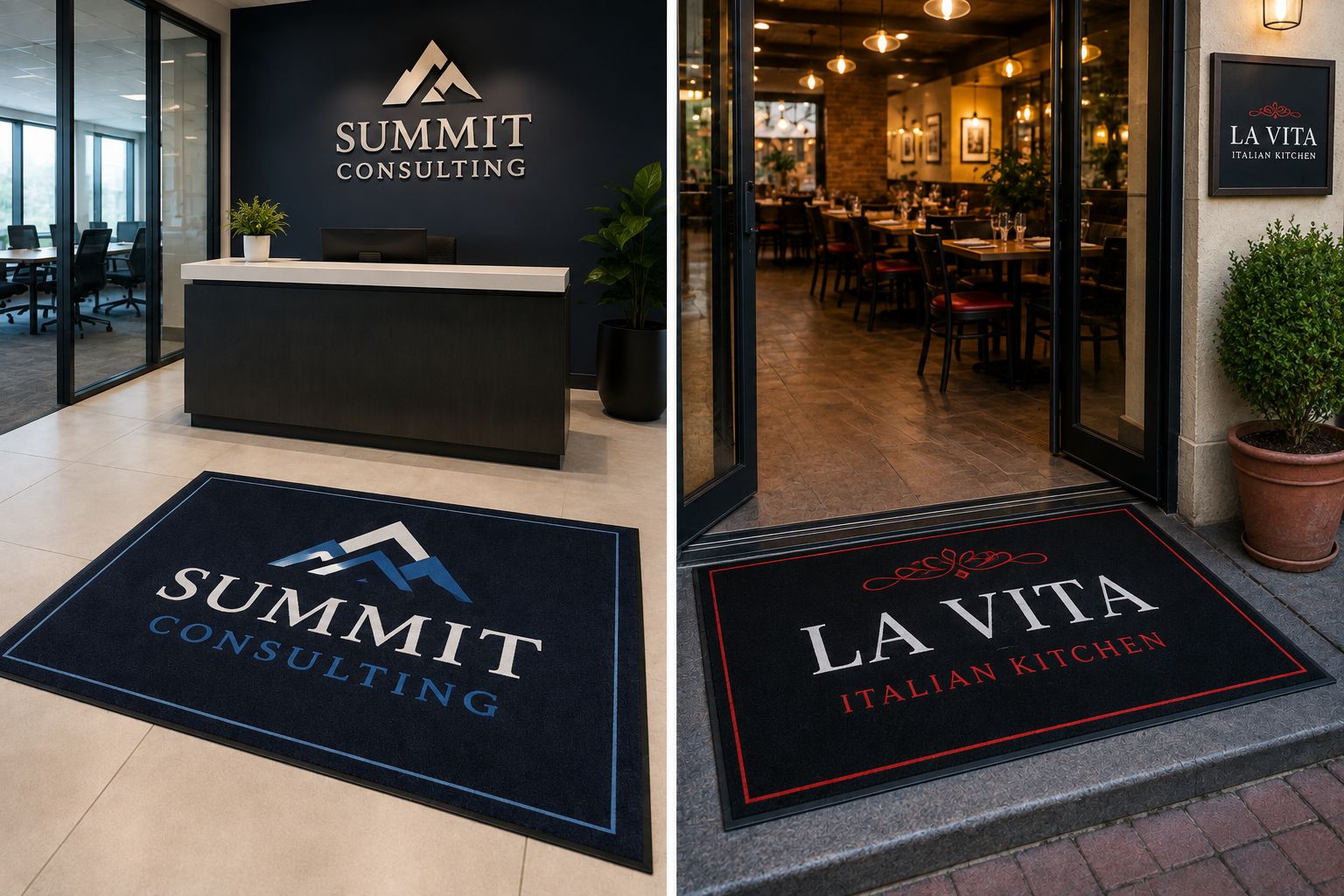
Should the logo fill the entire mat?
Usually not.
A logo needs enough breathing room around it to remain clear.
If the design is stretched too close to the edges, it can feel crowded and harder to recognise.
A strong mat design often has a simple structure:
Logo + business name + clear background
That is usually enough.
There is rarely a need to include phone numbers, websites, slogans, services and other promotional information unless there is a specific reason.
A branded mat is not meant to be a flyer.
Which colours work best on custom logo mats?
Choose colours that fit your existing visual identity, but also think about practicality.
Very light colours may show dirt more quickly in busy entrances.
Very dark colours can sometimes hide dirt better, but the logo still needs enough contrast to remain visible.
The smartest option is normally to use your existing brand colours in a way that still works in a floor environment.
If your company uses several colours, you do not necessarily need to use all of them.
A simpler version of your branding may actually look more professional.
How much foot traffic should you expect?
Foot traffic should influence your decision heavily.
A business with 20 visitors a day does not place the same demands on a mat as a busy store with hundreds of customers.
Ask yourself whether the entrance is:
Low traffic: small office, consultation room, private reception
Medium traffic: salon, showroom, small shop, clinic
High traffic: shopping centre retailer, busy restaurant, large office building
The more traffic the entrance receives, the more important durability and easy maintenance become.
Indoor or outdoor: does it matter?
Yes.
Not all mats are intended for the same environment.
Outdoor or semi-outdoor entrances may deal with moisture, dirt and direct weather exposure.
Indoor mats generally have a more controlled environment.
If the entrance sits just inside a door, it may still receive wet shoes during rainy weather.
This is why businesses should think about the actual position of the mat rather than simply calling it “indoor” or “outdoor.”
How important is durability?
Very important, especially for commercial environments.
A mat that looks excellent on the first day but starts wearing quickly does not create a good long-term impression.
Businesses should consider how often the mat will be walked on and whether it will be exposed to heavy use.
Durability becomes especially important for:
- Retail shops
- Restaurants
- Schools
- Medical practices
- Gyms
- Showrooms
- Busy office buildings
A commercial entrance mat should be chosen with everyday use in mind, not just appearance.
How often should branded mats be cleaned?
That depends on traffic and environment.
A low-traffic office may need only routine maintenance.
A restaurant or busy shop may need attention much more frequently.
The main thing is not to let the mat become part of the problem.
A dirty branded mat sends exactly the opposite message to the one it is supposed to create.
It should support professionalism, not undermine it.
Can branded mats help customers find the right entrance?
Yes, especially in buildings with several businesses or offices.
A branded mat can make the correct entrance easier to recognise.
This is useful for:
- Business parks
- Shared office buildings
- Shopping centres
- Clinics
- Salons
- Professional practices
If customers are unsure which door belongs to your business, a clear logo at the entrance can make identification easier.
Should every branch use the same mat design?
If a business operates multiple locations, consistency is usually a good idea.
Using the same logo style and general design across branches strengthens recognition.
The sizes may differ because every entrance is different, but the branding should still feel consistent.
A customer visiting one branch should immediately recognise the same business identity at another.
This is especially useful for franchises, chains and multi-location service businesses.
What are the most common mistakes businesses make?
One mistake is choosing based only on appearance.
Another is trying to fit too much information onto the design.
Businesses also sometimes order a mat without measuring the entrance first.
The most common issues are:
- Mat too small for the doorway
- Logo too detailed
- Poor colour contrast
- Too much text
- Material not suitable for traffic
- Design that does not match the business
A little planning before ordering can avoid all of these problems.
Should your branded mat match your other marketing materials?
Yes, as closely as practical.
Customers should see the same business identity across your physical and printed materials.
If your logo looks completely different on your mat, website and packaging, the brand can feel inconsistent.
A business might use its logo on the entrance mat, custom stickers on packaging and products, and rubber stamps on documents or administrative paperwork.
The aim is not to put branding everywhere.
It is to make sure that wherever the brand appears, it feels like the same company.
Can mats work as part of promotional branding?
Yes, but their role is different from promotional products.
A mat stays at the business premises and reinforces the brand whenever someone visits.
Promotional items travel with the customer.
For example, some businesses may use custom magnets to keep their contact details visible in customers’ homes, while using a branded mat to strengthen the physical customer experience at the entrance.
Both support recognition, but in different places.
What should you choose for an office?
For an office, focus on professionalism, clean design and proper sizing.
A simple logo usually works well.
The mat should feel like part of the reception environment, not an advertisement placed on the floor.
What should you choose for a shop?
For a shop, prioritise durability and visibility.
Customers should be able to recognise the business immediately, and the mat needs to cope with frequent use.
What should you choose for a restaurant?
For a restaurant, cleanliness and appearance matter equally.
The mat should complement the style of the venue and help make the entrance feel well maintained.
What should you choose for a reception area?
For a reception, think about presentation first.
Choose a size and design that work naturally with the interior and make the entrance feel polished.
Is a custom branded mat worth the investment?
If customers regularly visit your premises, it can be.
A good mat solves several problems at once.
It helps with cleanliness, improves presentation, reinforces your identity and makes the entrance feel more professional.
That makes it more useful than a purely decorative item.
The strongest branded mats are not the ones with the biggest logos or the brightest colours.
They are the ones that look right for the business, fit the space properly and continue doing their job every day.
Final thoughts
Choosing the right branded mat starts with understanding the entrance itself.
An office may need elegance.
A retail store may need durability.
A restaurant may need something easy to maintain.
A reception area may need a design that strengthens the overall look of the space.
Once you understand the environment, choosing the correct size, design and branding becomes much easier.
A well-chosen business floor mat should feel natural when customers walk in. It should not demand attention, but it should quietly tell them that they have arrived at a business that cares about how it presents itself.


