
A company rubber stamp looks simple, but deciding what to put on it can be surprisingly confusing. Should it show your registration number? Do you need your address? What about your VAT number? And does a South African business legally need a company stamp at all?
The best company stamp is not the one with the most information. It is the one that makes everyday paperwork faster while keeping the important details clear and readable.
For most businesses, that means starting with the registered company name and then adding only the information that matches how the stamp will actually be used.
DC Labels creates custom rubber stamps for businesses that need practical stamps for documents, administration, packaging and day-to-day office use.
Does a Company Need a Rubber Stamp in South Africa?
A useful distinction is often missed here: having a rubber stamp and complying with business-document requirements are not the same thing.
The Companies Act governs how companies are registered and managed, while CIPC maintains the official company information, including the registered name and registration details. CIPC also allows businesses to retrieve their official registration documents electronically.
A rubber stamp is therefore primarily an administrative tool. It can make it much faster to place frequently used company information onto documents, but businesses should not assume that stamping a document automatically makes that document legally compliant.
This becomes particularly important with invoices. SARS sets specific requirements for valid tax invoices, including details such as the supplier’s name, address and VAT registration number where applicable. Those requirements apply to the invoice itself; simply placing a company stamp on an incomplete invoice does not replace the required invoice information.
What Should Be on a Basic Company Rubber Stamp?
For many South African companies, a simple stamp works best.
A practical format could look like this:
ABC SOLUTIONS (PTY) LTD
Reg. No. 2026/123456/07
That may be all a business needs if the stamp is mainly used to identify the company on internal documents, forms or paperwork.
If customers frequently need to contact the business, you could add a telephone number or email address. If the stamp is primarily used on delivery paperwork or correspondence, adding the business address may also make sense.
The key is to design the stamp around its purpose rather than trying to squeeze every company detail onto it.
Should You Put Your Company Registration Number on the Stamp?
For a registered company, including the CIPC registration number is usually a sensible choice.
The registration number uniquely identifies the company and separates it from businesses that may have similar trading names. SARS also uses the CIPC registration number when identifying registered companies in its business registration processes.
A typical company stamp could therefore read:
MOKA TRADING (PTY) LTD
Reg: 2026/123456/07
If space is limited, there is rarely a need to write “Company Registration Number” in full. “Reg. No.” followed by the number is normally much cleaner.
Should the Stamp Use the Registered Name or Trading Name?
Where possible, use the registered business name if the stamp will be used on formal company documents.
CIPC and SARS distinguish between registered company information and, in some situations, a trading name. SARS business-registration guidance specifically refers to both the registered name and trading name where applicable.
If your customers know your business primarily by a trading name, you can include both when space allows.
For example:
SUNRISE PROJECTS (PTY) LTD
Trading as Sunrise Plumbing
Reg. No. 2026/123456/07
That immediately tells someone both the legal entity they are dealing with and the brand they recognise.
However, avoid overcrowding a very small stamp. If the registered name and trading name make the design difficult to read, a larger stamp may be the better option.
Should Your VAT Number Be on the Company Stamp?
Only include a VAT registration number if the business is actually VAT registered and the stamp is being used in a context where displaying that number is useful.
This point matters because VAT registration creates specific obligations. SARS requires VAT vendors to issue compliant tax invoices where required, and the VAT registration number forms part of the prescribed information on a tax invoice.
A VAT-related company stamp might therefore contain:
ABC DISTRIBUTORS (PTY) LTD
Reg. No. 2026/123456/07
VAT No. 4123456789
But remember: adding a VAT number to a rubber stamp does not turn an ordinary document into a valid tax invoice. The invoice still needs all the information SARS requires.
If your business is not VAT registered, don’t add “VAT No.” simply because you’ve seen it on another company’s stamp.
Should You Include Your Business Address?
An address can be useful, but it is not necessary on every stamp.
Consider including it if the stamp is regularly used on correspondence, delivery documents, forms or paperwork where customers need to know where the business is located.
However, long addresses can quickly make a stamp crowded.
Compare these two designs:
Example 1
ABC Engineering (Pty) Ltd
Reg. No. 2026/123456/07
45 Industrial Road
Midrand, Gauteng, 1685
Tel: 011 123 4567
accounts@abcengineering.co.za
Example 2
ABC Engineering (Pty) Ltd
Reg. No. 2026/123456/07
011 123 4567
The first contains more information, but the second may be much easier to stamp clearly on smaller documents.
CIPC stresses the importance of companies maintaining accurate registered-office information because that address is relevant to official company records and service of legal documents.
That does not mean every rubber stamp needs the complete registered address. It means that if you decide to print an address on your stamp, make sure it is current.
Should You Put a Phone Number and Email Address on the Stamp?
This depends entirely on how the stamp will be used.
If the stamp appears on customer-facing paperwork, adding a contact number can be useful because it gives the customer an immediate way to reach you.
A stamp used only for internal administration may not need contact information at all.
For example, a quotation approval stamp might simply say:
APPROVED
Date: __________
Authorised by: __________
while a general business stamp could show:
NKOSI MAINTENANCE (PTY) LTD
Reg. No. 2026/123456/07
Tel: 082 123 4567
www.nkosimaintenance.co.za
Different jobs justify different stamps.
Can You Add Your Company Logo?
Yes, and for customer-facing documents it can make the stamp more recognisable.
A logo stamp can work well on packaging, thank-you cards, envelopes, receipts or branded paperwork.
However, detailed logos do not always reproduce well at very small sizes. If your logo contains fine lines, gradients or tiny wording, a simplified version may produce a cleaner impression.
For product packaging in particular, some businesses combine a logo stamp with professionally printed custom stickers so they can use the stamp for simple paperwork and stickers where full-colour branding is more important.
What Should You Avoid Putting on a Company Stamp?
The most common mistake is trying to include everything.
A company stamp is not a business brochure.
You generally don’t need your full list of services, multiple phone numbers, every social-media profile, a slogan, website, physical address, postal address, email, VAT number and registration number all squeezed into a tiny rectangle.
If someone cannot read the impression easily, the additional information has defeated the purpose of the stamp.
Another mistake is including details that change frequently. A mobile number belonging to a temporary employee or an old address can quickly make the stamp obsolete.
Stick to stable information whenever possible.
What Size Company Stamp Should You Choose?
The size should follow the amount of information, not the other way around.
If you only need a company name and registration number, a compact rectangular stamp may be sufficient.
If you want your logo, registered name, VAT number, telephone number and address, choose a larger format so everything remains readable.
Reducing the font until six lines fit into a tiny stamp normally produces a poor result.
A clean impression is more useful than a crowded one.
What About an “Official Company Stamp”?
People often search for an “official company stamp” because they have been asked to stamp a document.
In practice, different organisations may have their own administrative requirements. A bank, customer, supplier, school, government department or other institution may request a company stamp on a particular form.
That does not mean every company stamp needs exactly the same information.
If the stamp will regularly be used for a specific organisation or process, look at what that document actually asks for before having the stamp made.
For many general business situations, your registered company name and registration number provide a strong starting point.
Should Directors’ Names Be on the Stamp?
Usually, there is little reason to place directors’ names on a general company stamp.
Directors can change, and CIPC maintains formal company records relating to directors and other company information.
A business stamp normally represents the company rather than one individual.
If a particular employee or director needs to authorise documents, a separate stamp can make more sense:
AUTHORISED BY
Name: __________
Signature: __________
Date: __________
This keeps the main company stamp useful even if personnel change.
Do You Need More Than One Rubber Stamp?
For many businesses, yes.
Instead of creating one enormous stamp that tries to perform every function, separate stamps can make administration much easier.
A company might have a main identification stamp showing its business details, plus specialised stamps such as PAID, RECEIVED, APPROVED, COPY, or a dated stamp for documents.
For example, the accounts department may need a “PAID” stamp while the reception desk needs a simple company-details stamp.
This approach keeps each impression clear and purpose-specific.
Company Stamps for Invoices and Quotations
If you use a company stamp on quotations or invoices, think carefully about what problem the stamp is solving.
If your accounting software already prints your company name, address, registration information and VAT details automatically, repeating everything with a stamp may add little value.
A stamp might instead be useful for:
PAID – DATE: ______
or
RECEIVED – DATE: ______
For VAT invoices specifically, businesses should ensure the actual invoice includes the particulars required by SARS rather than relying on the stamp to provide missing information. SARS states that valid tax invoices must contain prescribed details relating to the supplier, recipient and transaction.
Company Stamps for Packaging
Small businesses often use rubber stamps as an affordable way to personalise packaging.
A simple logo or business-name stamp can be applied to suitable:
- Paper bags
- Boxes
- Envelopes
- Thank-you cards
- Tags
This works particularly well for small quantities or businesses that want a handcrafted presentation.
When larger quantities or more colourful branding are needed, printed stickers may provide a better alternative.
Businesses can also use custom magnets as promotional giveaways while keeping the rubber stamp focused purely on administration and packaging.
How Do You Choose the Right Information?
A useful test is to ask:
What do I want someone to know immediately after seeing this stamp?
If the answer is “which company issued this document,” use the registered name and registration number.
If the answer is “how can the customer contact us,” add a phone number or website.
If the answer is “has this invoice been paid,” you probably need a PAID stamp rather than a large company-details stamp.
If the answer is “I want my packaging to look branded,” your logo and business name may matter more than your registration details.
The purpose should determine the design.
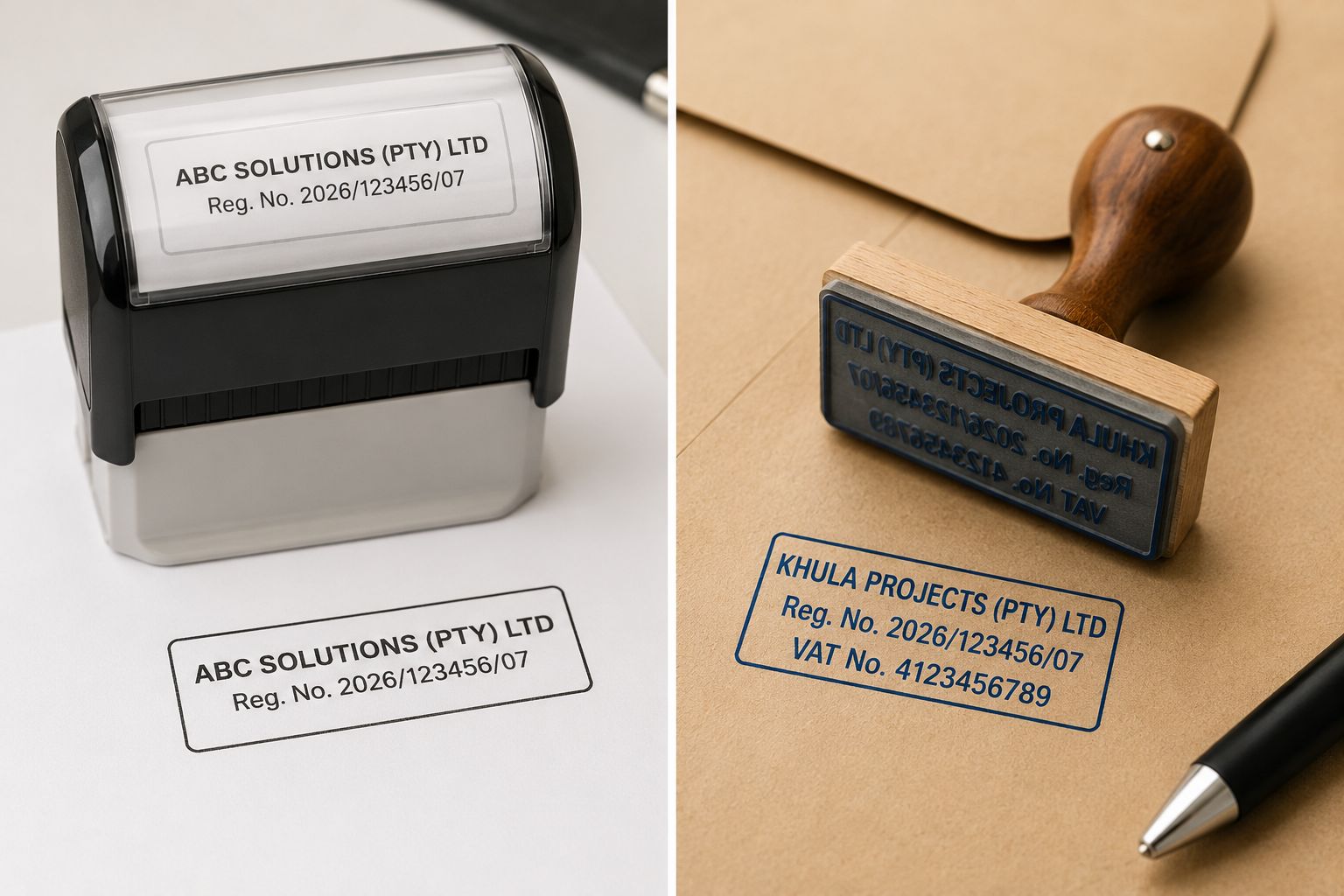
A Good Company Stamp Example for a South African Business
For a typical registered business, a practical design could be:
KHULA PROJECTS (PTY) LTD
Reg. No. 2026/123456/07
Tel: 011 555 1234
www.khulaprojects.co.za
For a VAT-registered company that regularly uses the stamp on business paperwork:
KHULA PROJECTS (PTY) LTD
Reg. No. 2026/123456/07
VAT No. 4123456789
011 555 1234
And for a very simple administrative stamp:
KHULA PROJECTS (PTY) LTD
Reg. No. 2026/123456/07
There is no advantage in making the stamp more complicated unless the extra information serves a real purpose.
Get a Company Rubber Stamp That Actually Works for Your Business
The best business rubber stamp is clear, practical and designed around the documents you use every day.
For many South African companies, the registered company name and registration number provide the foundation. From there, you can add a VAT number, contact details, address or logo where they genuinely make the stamp more useful.
Avoid turning your stamp into a miniature advertisement. Customers and staff should be able to understand the impression immediately.
DC Labels produces custom business stamps for companies that need clear, professional impressions for paperwork, packaging and everyday administration. Businesses with physical premises can also extend the same professional branding to reception and entrance areas with branded mats.
The goal is simple: put the right information in the right space, and make the stamp useful every time you press it.
Frequently Asked Questions
What is the most important information to put on a company stamp?
For a registered company, the registered business name and CIPC registration number are usually the most useful starting point. Additional information should depend on how the stamp will be used.
Should I put my VAT number on my company stamp?
If your business is VAT registered and the stamp is used on relevant business documents, including the VAT number can be useful. A stamp does not replace the other information SARS requires on a valid tax invoice.
Can my company logo be included?
Yes. A simplified version of your logo can make customer-facing documents and packaging more recognisable.
Should I add my full address?
Only if it is useful for the documents you normally stamp. If the address makes the impression overcrowded, keep the stamp simpler.
Can I have separate stamps for PAID, RECEIVED and APPROVED?
Yes. In many offices, specialised administrative stamps are more practical than trying to place every function onto one company stamp.